

REVIEW · AUDIO TOURS
Helsinki Self-Guided Audio Tour
Helsinki rewards curious walkers. This $6 self-guided audio tour links grand architecture, seaside markets, museums, churches, and quiet coastal spots across the city. I like the freedom to choose your route, and I like the six-day access window, which lets you split the experience into manageable outings. The main drawback is distance: seeing all 26 stops takes far longer than the advertised three hours.
I also appreciate the low price and the useful pairing of a SoundCloud audio playlist with a Google My Maps route. You can listen only to the sights that interest you, stop for coffee, and skip admission-charging museums without losing the rest of the tour.
This is not a live guided walk and it is not GPS-guided. You must carry your own charged phone, headphones, and internet connection, then select each attraction yourself. The audio may also feel brief if you want long, lecture-style explanations.
In This Review
- Key points to know before you go
- What this $6 Helsinki tour really offers
- Central Helsinki begins with granite and neoclassical drama
- Senate Square tells Finland’s political story
- Orthodox domes, market stalls, and the harbor
- Suomenlinna needs its own half-day plan
- Modern Helsinki comes into focus around Kamppi
- Museums and churches add depth, but also add cost
- A quieter western route through memory and music
- Seurasaari, Kallio, and the city’s outer edges
- How the audio and map work in practice
- Is the $6 price good value?
- Who should book it?
- FAQ
- How much does the Helsinki Self-Guided Audio Tour cost?
- How long does the tour take?
- Is the tour guided by GPS?
- How do I receive the audio guides?
- How long do the access links remain valid?
- What do I need to bring?
- Are admission fees included?
Key points to know before you go
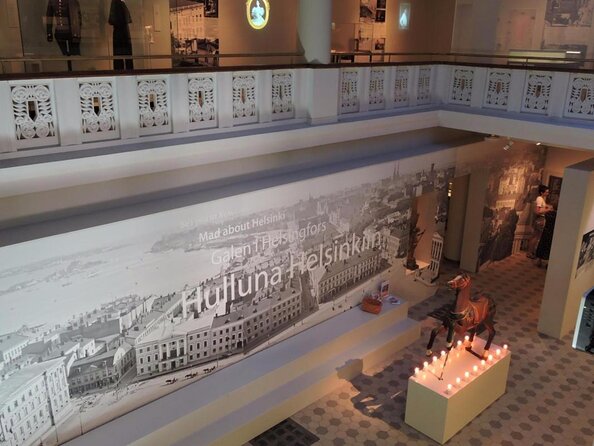
- Twenty-six stops cover far more than central Helsinki, from Central Railway Station and Senate Square to Suomenlinna, Seurasaari, and Kivinokka.
- The $6 price is excellent for selective sightseeing, but museum and Suomenlinna entry fees are extra, as is transportation.
- Two private links do the work: one SoundCloud playlist for narration and one Google My Maps page for locations and individual audio tracks.
- Six days of access makes a two-day plan sensible, especially if you want to include museums, Suomenlinna, or the outer districts.
- The tour suits independent walkers, not anyone seeking a personal guide, live conversation, or automatic turn-by-turn directions.
- The strongest themes are architecture, independence, design, religion, Finnish culture, and the city’s close relationship with nature.
What this $6 Helsinki tour really offers

I see this experience as a large menu, not one fixed walking tour. The suggested list contains 26 locations, but you decide which ones deserve your time, where you begin, and where you finish.
The audio links remain available for up to six days. That matters because the full route is too spread out for most people to complete in one pleasant day. One user sensibly divided the walking into two days, and I would recommend the same approach if you plan to enter museums or make the trip to Suomenlinna.
The audio is offered in English, and the materials arrive through the booking platform’s messaging system before your selected start time. Open the SoundCloud link in a browser to find the playlist. Open the Google My Maps link in a browser, not the Google Maps app, to see the marked attractions and their individual audio links.
That setup is simple once you understand it, but it is not completely hands-free. I would open both links before leaving your accommodation, charge your phone fully, and use headphones or earphones. You need internet access, and the tour does not provide an audio device.
A few more options to weigh up in Helsinki
- Helsinki: Sightseeing Canal Cruise with Audio Commentary
★ 4.5 · 1,299 reviews - Helsinki: Bus Tour with Audio Guide
★ 4.3 · 544 reviews - Explore Tallinn: Self-Guided Day Cruise from Helsinki
★ 4.5 · 212 reviews
Central Helsinki begins with granite and neoclassical drama
Start at Helsinki Central Railway Station, one of the best orientation points in town. Eliel Saarinen’s granite building brings together Art Nouveau and Finnish National Romantic ideas, with the famous lamp-bearing figures guarding the entrance. The audio explains the station’s symbolism, its role as an unofficial town square, and the design contest that could have produced a very different building.
From there, Kaisaniemi Botanic Garden gives you a change of pace. The greenhouse complex contains more than 800 plant species, including tropical plants that seem pleasantly out of place in a Nordic capital. The narration connects the garden with Finnish science, agriculture, plant collecting, and the survival of rare specimens during wartime.
Admission is not included at Kaisaniemi, so check the current opening arrangements before making it a priority. I would place it on a daytime route with the nearby National Library of Finland, rather than making a separate trip.
The library is one of Helsinki’s finest interiors. Carl Ludvig Engel designed it as a neoclassical monument to learning, and the audio points out its symbolic decoration, zodiac ceiling, rescued manuscripts, and underground book conveyor system. This is a good stop for architecture lovers who want more than a quick exterior photograph.
Senate Square tells Finland’s political story
Senate Square is the city’s great civic room. Its coordinated neoclassical buildings show how Helsinki was shaped under Russian imperial rule, while the square’s later use connects it with Finland’s independence and public celebrations.
The audio focuses on the square’s transformation from an earlier marketplace into a formal center of power. It also covers a buried time capsule, underground connections between government buildings, and the political conflicts that played out around these buildings.
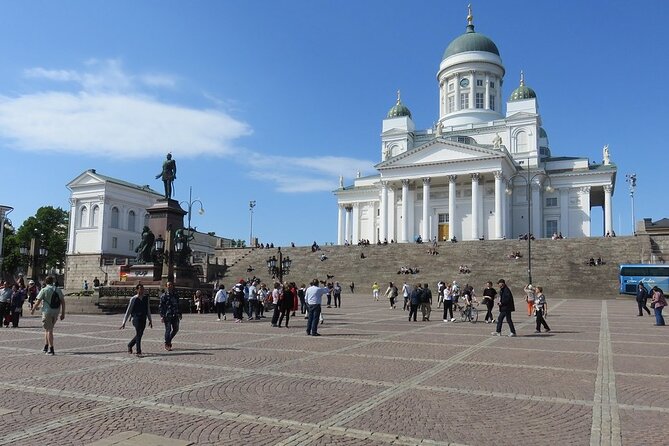
At the top of the square, Helsinki Cathedral provides the familiar white-and-green view seen on so many city postcards. The narration gives useful context about the cathedral’s original name, the political pressure behind its construction, and the architect’s effort to balance imperial expectations with Finnish character.
Inside, the guide discusses the building’s acoustics, wartime role, and symbolic details. The cathedral is free to enter, although religious services and special arrangements can affect access. I would visit the square and cathedral together, then walk toward the harbor.
Orthodox domes, market stalls, and the harbor
Uspenski Cathedral offers a strong contrast with the Lutheran cathedral. Its red brick, golden domes, Byzantine style, and Russian connections reflect another important part of Helsinki’s identity. The audio explains religious tolerance in Finland, the iconostasis, the craftsmen behind the sacred art, and the protection of icons during difficult periods.
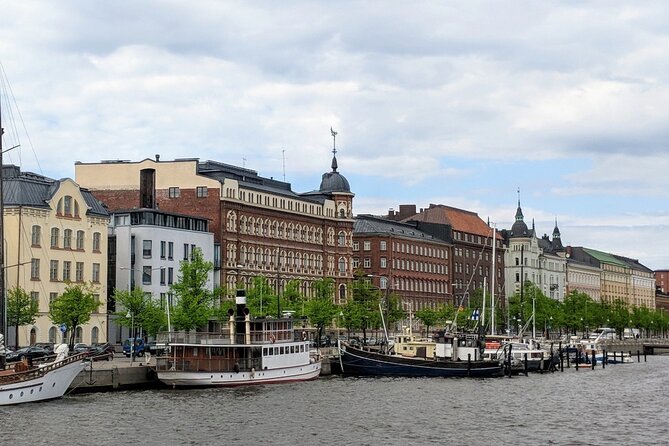
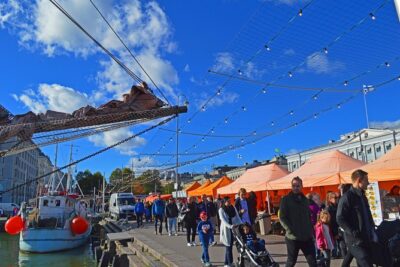
Next comes Kauppatori, Helsinki’s market square by the water. This is where the tour shifts from monumental buildings to daily life: fish, produce, prepared food, local customs, and the orange market tents. The narration traces the area’s trading past and explains how the market supported Helsinki’s growth.
The nearby Old Market Hall, opened in 1889, is worth entering even if you are not hungry. Its red-brick interior houses Finnish food traditions alongside international specialties. The audio covers its original food-storage design, merchant families, wartime rationing, and the businesses that continued across generations.
I like this part of the route because you can listen while seeing the city function around you. It also gives you natural places to pause. Food and drinks are not included, but the hall and market provide obvious opportunities to buy your own.
A completely different kind of day:
- A Finntastic Walking Tour in Helsinki
★ 5.0 · 700 reviews - From Helsinki: Nuuksio National Park Half-Day Trip
★ 4.8 · 688 reviews - Helsinki: Tallinn Guided Day Tour with Ferry Crossing
★ 4.6 · 670 reviews - Helsinki: Hop-On Hop-Off City Bus Tour
★ 4.2 · 585 reviews
Suomenlinna needs its own half-day plan

Sea Fortress Suomenlinna is the biggest detour and one of the most important stops. The island fortress is a UNESCO World Heritage site with Swedish origins, military defenses, tunnels, residential streets, and a long record of sieges, surrender, imprisonment, and civilian life.
The audio presents Suomenlinna as more than a collection of walls. It explains the fortress as a protector, prison, cultural center, and living neighborhood. That last point matters: people still live there, so you need to treat it as a real community rather than an open-air stage set.
Entry to the fortress itself is not included, and transportation is also excluded. The tour does not provide pickup or drop-off. Plan Suomenlinna separately and allow enough time for the journey, the island walk, and the sites you want to see. Its distance is one reason the whole 26-stop experience cannot realistically be treated as a single short stroll.
Back on the mainland, Havis Amanda makes a fine harbor-area companion stop. The bronze mermaid caused controversy when unveiled in 1908, and the narration explains the scandal, the statue’s symbolism, and its transformation into a focus of May Day celebrations.
Esplanadi Park then brings you into Helsinki’s social center. The audio covers the park’s bandstand, cultural performances, political gatherings, landscape design, and role in public celebrations. I would visit this stretch during the day, when you can combine sightseeing with a meal or a relaxed walk.
Modern Helsinki comes into focus around Kamppi
Kamppi Chapel of Silence is one of the tour’s most distinct modern stops. The wooden structure was designed to provide calm in one of the city’s busiest areas. Its unusual construction creates strong acoustic separation from the surrounding noise, while the interior reflects Finnish woodworking and contemporary spiritual needs.
This is a short, focused visit rather than a conventional church tour. The audio discusses the chapel’s design ideas, sustainable construction, and role in community healing. Respect the quiet atmosphere and keep your listening discreet.
At Kiasma, Helsinki’s Museum of Contemporary Art, the building itself becomes part of the visit. Its curved forms and adaptable galleries were controversial when proposed near the historic center. The narration covers the architectural debate, gallery design, conservation areas, and the museum’s role in Finland’s modern art scene.
Kiasma requires an admission fee, so it makes sense to check whether its exhibitions match your interests before paying. If you skip the museum, you can still use the audio to understand the building from outside.
Across the way, Central Library Oodi presents a more open idea of public culture. The audio explains how its design supports reading, making, learning, technology, and community use. Oodi is not simply a place to borrow books. It represents Finnish ideas about education, equality, and shared civic space.
The Parliament House adds the political counterpoint. Its granite exterior and formal design reflect the seriousness of Finnish democracy, while the audio covers parliamentary traditions, historic debates, wartime sessions, security features, and the art inside the building.
Museums and churches add depth, but also add cost

The Natural History Museum is a strong choice if you want Finland’s wildlife and scientific work included in your city visit. Displays range from dinosaur fossils to Arctic animals, and the narration explains research expeditions, specimen storage, conservation, and climate change work.
Admission is not included. I would choose it for a rainy day or for a family itinerary, but not assume you can fit it casually between outdoor stops.
Temppeliaukio Church, carved into solid rock, is one of Helsinki’s signature buildings. The audio explains the engineering problems behind the project, the architectural competition, the preserved rock formations, the copper dome, and the church’s celebrated acoustics.
This church also charges admission, and access can vary with services or events. The setting rewards a quiet visit, so you may want to pause the narration once you have heard the main explanation and simply listen to the space itself.
The National Museum of Finland gives the city’s story a broader frame, from prehistoric settlement to independence and modern national identity. The audio connects objects with the collectors and scholars who preserved them, and it discusses artifacts that survived war and political upheaval.
Admission is extra here as well. If you choose only one major museum from this part of the route, I would base the decision on your interests: natural science, modern art, Finnish history, or everyday urban life.
A quieter western route through memory and music

Hietaniemi Cemetery offers a slower, more reflective stop. It contains the graves of notable Finnish artists, politicians, presidents, and public figures. The audio uses the cemetery’s memorials and biographies to explain Finnish ideas about achievement, remembrance, and national identity.
The Sibelius Monument follows naturally. Its cluster of steel tubes honors composer Jean Sibelius in an abstract form that sparked debate when unveiled. The audio covers the sculpture’s design, its organ-pipe effect, Sibelius’s connection with Finnish independence, and the public argument over how a composer should be represented.
The nearby Toolo Bay shifts attention from people and monuments to city planning. A former industrial harbor area became a recreational corridor with paths, wildlife, and open views. The narration discusses water quality, winter activities, urban design, and Helsinki’s effort to keep nature close to daily life.
Seurasaari, Kallio, and the city’s outer edges
Seurasaaren Ulkomuseo presents Finnish rural life through historic buildings moved from different parts of the country. The audio explains the buildings’ origins, construction methods, household traditions, and the difficult work involved in relocating and preserving them.
Admission is not included, and this is another stop that deserves time rather than a quick pass. I would choose it if you want traditional Finnish culture and buildings, not just central-city architecture.
Kallion Kirkko rises above the Kallio district with its granite form and tall bell tower. The narration explores the church’s social role, progressive clergy, working-class connections, wartime services, organ, and concert acoustics.
At Kumpula Botanical Gardens, science takes center stage again. This garden supports research into plant diversity, rare species, adaptation, and climate change. The audio helps you see the site as both a public garden and a working scientific facility.
The final stop, Kivinokka, takes you to a coastal recreation area shaped by ice-age glaciers. Rocky shores, Baltic water, seasonal changes, and the Finnish habit of seeking nature near the city all receive attention in the narration.
These outer stops are not practical add-ons to a central walking loop. Use public transportation or plan separate outings, since transportation is not supplied. Their value is greatest when you have extra time and want to see how Helsinki extends beyond its postcard center.
How the audio and map work in practice
The playlist is arranged in a suggested order, but you do not have to follow it. You can listen before your visit, then select only the tracks for the places you actually reach.
The map uses headphone icons to mark the 26 attractions. Tap an icon, or open the tour title below the map to see the full list. Each location includes a link to its matching audio guide.
That arrangement gives you control, but you need to manage the route yourself. The product is not GPS-guided, so it will not automatically tell you when to turn or warn you that two stops are far apart. I would group the attractions geographically:
- Central Station, Kaisaniemi, the National Library, Senate Square, and the cathedral
- Uspenski Cathedral, Kauppatori, Old Market Hall, Havis Amanda, and Esplanadi
- Kamppi Chapel, Kiasma, Oodi, Parliament, and the museums
- Hietaniemi, Sibelius Monument, Seurasaari, Toolo Bay, Kallio, Kumpula, and Kivinokka
- Suomenlinna as a separate outing
Is the $6 price good value?
At $6 per person, the price is hard to criticize if you use even part of the material. A conventional guided tour costs more and follows someone else’s timetable. Here, you receive audio for 26 attractions, an interactive map, and access for up to six days.
The value drops if you expect long, detailed lectures at every stop. One piece of feedback praised the information but wished the tracks were longer and more detailed. Another found the narration too brief and felt basic practical facts were not enough.
That difference points to the right expectation. Treat this as a low-cost orientation tool with historical and cultural context, not as a substitute for a specialist guide, museum curator, or full research library. The short format can be useful when you want to keep walking, but it will not satisfy everyone who wants dense historical analysis.
The tour has a 3.7 rating from 14 reviews, which suggests a mixed but worthwhile experience for the right audience. Pay close attention to the language selection during booking. English is offered, but the chosen language is tied to the booking, and the access instructions should be checked before departure.
Who should book it?
I would recommend this tour to independent visitors who enjoy building their own day. It works especially well for first-time visitors who want a broad list of sights, budget-conscious explorers, couples with different interests, and anyone staying in Helsinki for several days.
It is less suitable if you want a guide walking beside you, live answers to questions, hotel pickup, included admissions, or automatic navigation. It also demands more planning than the word self-guided might suggest.
Book it if you will use the flexibility. Start with the central sights, reserve another day for Suomenlinna, and add museums only after checking their entry arrangements. Bring headphones, a charged smartphone, and internet access. For $6, you get a useful framework for seeing Helsinki on your own terms, provided you understand that the walking, transport, tickets, and route decisions remain yours.
FAQ
How much does the Helsinki Self-Guided Audio Tour cost?
The tour costs $6 per person.
How long does the tour take?
The estimated duration is approximately three to nine hours. Visiting all 26 attractions can require more time, especially because several stops are spread across Helsinki and some require admission or separate transportation planning.
Is the tour guided by GPS?
No. This is not a GPS-guided tour. You choose the order, route, starting point, ending point, and length of each visit.
How do I receive the audio guides?
You receive private access links through the booking platform’s messaging system on your selected travel date, before your start time. One link opens the SoundCloud audio playlist, and the other opens the Google My Maps itinerary.
How long do the access links remain valid?
The private links remain valid for up to six days.
What do I need to bring?
You need a fully charged smartphone, headphones or earphones, and internet access. Audio devices, food, drinks, transportation, and required entry fees are not included.
Are admission fees included?
No. Entry fees are not included where attractions charge them. The listed paid stops include Kaisaniemi Botanic Garden, Suomenlinna, Kiasma, the Natural History Museum, Temppeliaukio Church, the National Museum of Finland, and Seurasaaren Ulkomuseo.
Just added in Helsinki
- VIP Highlights Helsinki City PRIVATE Tour★ 5.0 · 1 review
- Wildlife safari with campfire dinner from Helsinki★ 5.0 · 8 reviews
- Traditional smoke sauna experience and national park visit★ 5.0 · 10 reviews
- Private Porvoo Tour & Visit Runeberg’s National Poet House★ 5.0 · 3 reviews
- Helsinki and Porvoo Private Tour by Luxury Car with Guide★ 5.0 · 16 reviews
- E-Bike rental / Self-Guided tour to Seurasaari★ 5.0 · 2 reviews
- Winter kayaking in Eastern Helsinki archipelago★ 5.0 · 3 reviews
- Private VIP Transfer from or to Helsinki Airport★ 4.5 · 11 reviews
Audio Tours, compared.

Sightseeing Canal Cruise with Audio Commentary
Read our review →
Helsinki Panorama Sightseeing Audio-Guided Bus Tour
Read our review →
Helsinki Highlights and Self Guided Audio Tour on Suomenlinna
Read our review →Browse the lists this tour appears in